


Direct Cloud connects the corporate network to cloud service providers via a dedicated connection. It ensures security, low latency, and service levels superior to those of the public Internet.
More and more companies are entrusting their business operations to applications delivered via public clouds. These environments often integrate with on-premises or private cloud solutions. In these hybrid scenarios, the quality of the connection to cloud service providers affects performance, the security of data in transit, and business continuity. Cloud connectivity is not merely a technical detail, but a key lever for governance and risk management. Direct Cloud services provide the most effective solution to these needs, ensuring a direct connection, predictable performance, and greater protection compared to the public Internet.
What Is Direct Cloud?
A direct connection to the cloud is a connectivity service that connects an organization’s network to cloud service providers via a private connection, without passing through the public Internet.
Direct Cloud (private cloud connection): a service that establishes a private and secure connection between the corporate network and Cloud Service Providers (CSPs), offering many advantages over a public Internet connection
Connecting to cloud service providers can be done in two ways. The first is via the public Internet: simple and widely used. However, it has the limitations of a shared medium: variable routes, unguaranteed latency, and exposure to interception. The second is a private connection. It provides a stable, controlled path between the corporate infrastructure and the provider. For business-critical workloads, this difference ensures predictable performance and traffic protection. The private connection thus functions as a fast lane for those handling sensitive data or latency-sensitive applications.
What is the difference between a private connection and a public Internet connection?
A private connection routes traffic over a dedicated, controlled network. The Internet, on the other hand, relies on a shared public network, operating on a best-effort basis and without contractual guarantees regarding latency and availability. This distinction affects security, performance, and the ability to monitor traffic flows to the cloud.
The Benefits of a Direct Connection to the Cloud
A private connection offers greater security, lower latency, reliability backed by high service levels, and granular control over traffic to cloud service providers.
Compared to the public Internet, the private mode routes traffic over a dedicated, controlled path. For enterprise organizations, the benefits are measurable in terms of operations and compliance. The flow of data to the cloud becomes predictable, secure, and verifiable. There are four main advantages.
- Greater security: Traffic is encrypted and routed through a dedicated network, reducing the risk of interception or intrusion.
- Lower latency: The direct connection between networks provides faster response times, improving the performance of cloud applications.
- High reliability: CSPs guarantee high uptime and SLAs for connections made in Direct Cloud mode.
- Greater control: the ability to monitor and manage traffic flow to and from the CSP.
According to Gartner (“Top Trends Shaping the Future of Cloud, 2025”), more than 50% of organizations will fail to achieve the expected results from their multicloud deployments by 2029, due to poor interoperability and difficulties connecting between providers. Private connectivity to each cloud mitigates this very risk.
Dedicated or Shared Interconnection
Direct interconnections are classified into two types: dedicated, where a physical resource is reserved for a single customer, and shared, where a virtual connection is established over an infrastructure shared by multiple customers.
Every cloud service provider offers its own interconnection service. For Microsoft Azure, it’s called ExpressRoute; for Oracle Cloud Infrastructure, it’s FastConnect. There are also Google Cloud Interconnect and AWS Direct Connect. The names vary, but the mechanisms are similar. They can be summarized into two categories. All services also allow for redundant configurations—which are mandatory in some cases—confirming their commitment to service levels.
- Dedicated: A private connection is established between CSP and the customer via a dedicated physical interconnection
- Shared: A private virtual connection is established between the CSP and the customer over a physical resource shared among multiple customers
How do you activate a Direct Cloud service?
The activation process consists of three phases: establishing the interconnection, provisioning on the provider’s portal, and configuring the routing. These activities involve both the connectivity provider and the end customer.
- Establishing the interconnection: a physical or virtual connection between the customer’s site and the cloud provider; typically performed by a connectivity provider interconnected with the CSPs (in Dedicated or Shared mode)
- Provisioning: Creating an account and activating the interconnection service through the CSP portal; typically performed by the Direct Cloud service provider
- Routing Configuration: Configuring routing tables to properly route traffic between the local network and the cloud; this is typically the responsibility of the end customer
According to IDC (FutureScape: Worldwide Enterprise Connectivity 2025), 53% of enterprises increased their connectivity spending in 2024 compared to 2023, with a growing share of investments directed toward cloud and data-driven projects. Direct connectivity channels this spending toward predictable and measurable connections.
Technical Specifications for the Direct Connection Service
The technical data sheet summarizes interconnection methods, port speeds, redundancy, regional coverage, and routing configurations to cloud service providers.
The following parameters describe the standard features of a direct cloud connection service. Specific bandwidth values and service levels are defined during the design phase, based on the organization’s application scenarios.
| Parameter | Specification |
|---|---|
| Interconnection Methods | Dedicated or shared, depending on bandwidth and resilience requirements |
| Gate Speed | Standard bandwidths ranging from 1 Gbps to 10 Gbps |
| Redundancy | Redundant configuration available; required for some providers |
| Regional coverage | Italian and European Regions of the Leading Cloud Service Providers |
| Routing | Dynamic Routing via BGP Between the Corporate Network and the Cloud |
| Traffic Safety | Traffic is encrypted and routed over a dedicated network, not over the public Internet |
Direct Cloud with Retelit: Speed, Resilience, and Control
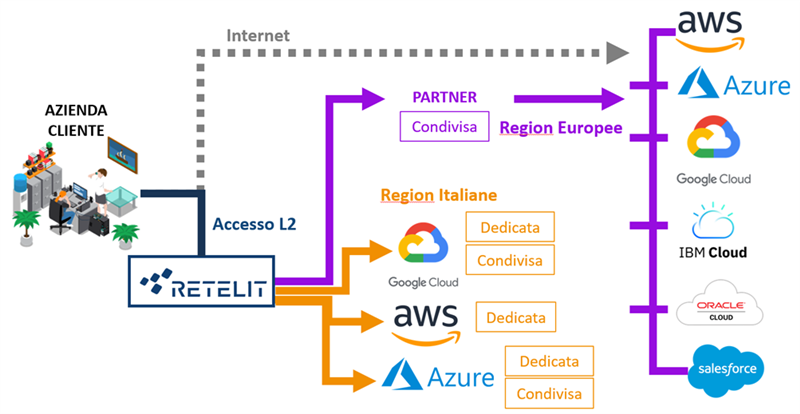
Retelit offers dedicated and shared direct interconnections to the Italian and European regions of the leading cloud service providers, enabling multi-cloud and hybrid-cloud architectures.
Retelit supports both interconnection modes, depending on requirements for speed, resilience, and destination. In dedicated mode, it hosts fiber interconnections with the Italian regions of the leading cloud service providers in the Avalon Campus data centers. In shared mode, it offers an alternative connection to Italian regions. Through a diverse network of partners, it also reaches the European regions of all major providers. This enables organizations to obtain dedicated, fast, and reliable connections to the cloud and to easily adopt multi-cloud and hybrid-cloud solutions.
Work with the Retelit team to determine the best solution for your architecture: learn more about enterprise connectivity options and request an assessment on the contact page.
Frequently Asked Questions About Direct Cloud
The Internet connection routes traffic over a shared public network, on a best-effort basis and without contractual guarantees. A direct connection uses a dedicated link between the corporate network and the cloud service provider, offering low latency, secure traffic, and documented service levels. It is the recommended choice for business-critical applications and sensitive data.
The private connection enables dedicated connections to multiple cloud service providers in parallel, as well as to on-premises infrastructure or private clouds. This enables multi-cloud and hybrid-cloud architectures. Workloads remain distributed across different environments, with predictable and governed connectivity.
Direct interconnections reach the major cloud service providers through their respective services: Microsoft Azure ExpressRoute, Oracle Cloud Infrastructure FastConnect, Google Cloud Interconnect, and AWS Direct Connect. Retelit provides dedicated access to Italian regions and access to European regions through partners.
In collaboration with Luca Cavobianchi, Product Marketing, Retelit